Anger is often treated as a problem that must be controlled.
When someone becomes irritable, raises their voice, withdraws or reacts defensively, the immediate advice is usually familiar:
“Calm down.”
“Do not overreact.”
“Control your temper.”
Learning to regulate anger is certainly important. Anger should never be used to justify intimidation, aggression, abuse or harm.
However, anger management is not only about becoming quieter. Sometimes, anger is trying to communicate something that the person has not yet understood.
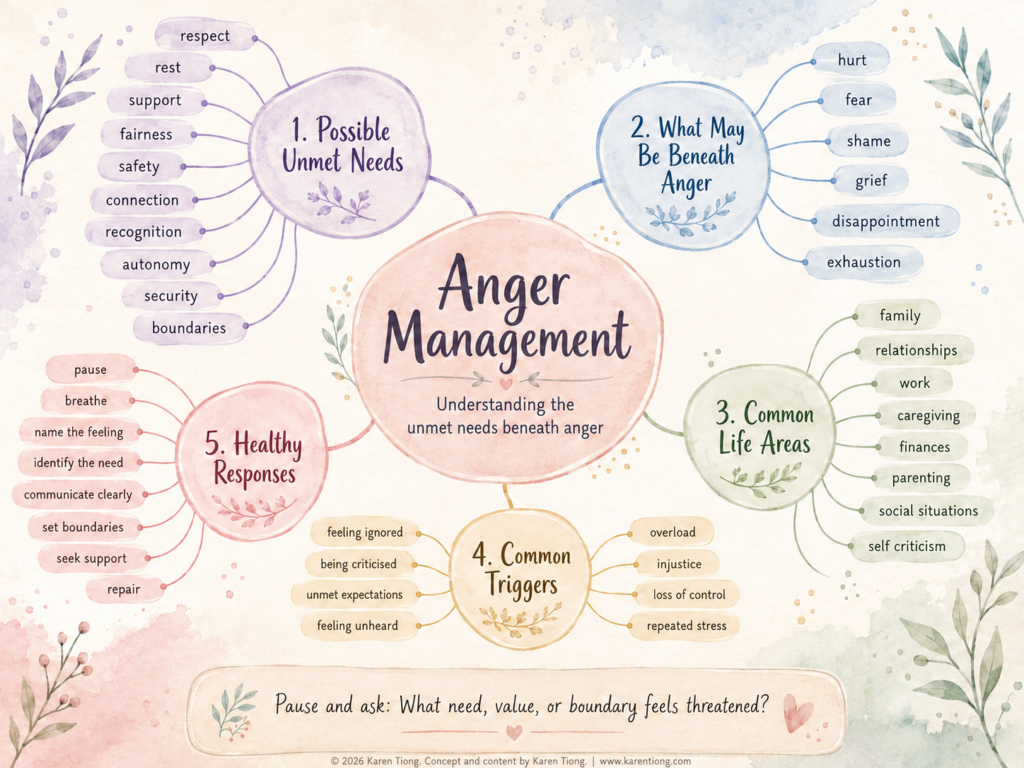
It may be signalling hurt, fear, exhaustion, injustice, disappointment, an unmet need or a boundary that has been crossed.
At other times, the person may genuinely have no idea why the anger feels so strong.
They may say:
“I know this situation should not affect me so much, but it does.”
“I became angry so quickly that I surprised myself.”
“I understand what happened, but I still cannot explain my reaction.”
“I have tried thinking about it, but I cannot find the answer.”
This uncertainty does not necessarily mean that the anger is meaningless. It may mean that the experience is not yet fully accessible through conscious thought or words.
The Trigger May Not Be the Whole Story
An unanswered message may trigger anger.
However, the deeper experience may involve feeling forgotten, unimportant or emotionally abandoned.
A critical comment may trigger defensiveness.
Yet beneath the reaction may be an earlier experience of humiliation, inadequacy or never feeling good enough.
A disagreement at work may produce unusually intense frustration.
However, the present disagreement may also touch a longstanding sensitivity towards unfairness, powerlessness or not being heard.
The current situation matters, but it may not explain the full intensity of the response.
Sometimes, the present moment touches something older.
This does not mean that every angry reaction must be traced back to childhood or trauma. Anger may also arise from immediate injustice, exhaustion, physical discomfort, accumulated stress or a genuine boundary violation.
The point is that the visible trigger and the deeper source are not always identical.
What Might Anger Be Protecting?
Anger can sometimes sit above emotions that feel more vulnerable or difficult to express.
Hurt
Saying “I am angry” may feel safer than saying:
“What happened really hurt me.”
Fear
Anger can provide a temporary sense of strength when a person feels threatened, uncertain or out of control.
Shame
A person who feels criticised or exposed may react defensively because acknowledging inadequacy feels unbearable.
Grief
Loss may appear through impatience, irritability or resentment rather than tears.
Exhaustion
When someone has been coping for too long, a relatively small event may become the final pressure point.
Helplessness
Anger may arise when a person repeatedly feels unable to influence what is happening.
The anger is real, but it may not be the only emotion present.
When You Cannot Identify the Unmet Need
Reflective questions can be helpful:
What am I really feeling?
What did I need in that moment?
What boundary was crossed?
What did I hope the other person would understand?
What am I afraid might happen?
Sometimes, the answer becomes clear.
At other times, nothing emerges.
The person may understand the event intellectually but remain unable to explain the emotional intensity.
This can be frustrating, particularly for someone who believes they should be able to reason their way through every reaction.
Yet emotional experiences are not always organised neatly into words.
A person may notice tightness in the chest, heat in the face, pressure in the throat, trembling, restlessness or a strong urge to withdraw before they can identify what the feeling means.
In such moments, the body may be expressing activation before the conscious mind has formed a clear explanation.
This is where counselling can offer another way of exploring the uncertainty.
Exploring Anger Through Brainspotting
Brainspotting is a therapeutic approach that combines focused visual attention, body awareness and relational attunement with a trained practitioner.
A person does not need to arrive with a complete explanation of their anger.
The starting point may simply be:
The situation that triggered the reaction.
The intensity of the anger.
A particular bodily sensation.
An image, thought or feeling connected with the experience.
The practitioner may guide the person to notice whether different positions within the visual field are associated with changes in emotional or bodily activation. The person then maintains attention on a relevant visual point while observing whatever thoughts, sensations, emotions or memories arise.
Brainspotting was developed from the clinical observation that bodily activation connected with a distressing experience may vary according to where a person looks. Proposed explanations for how it works remain theoretical, and its research base is still developing. Early studies have reported reductions in distress associated with difficult memories, but considerably more rigorous research is required before strong conclusions can be made.
For this reason, Brainspotting should not be presented as a method that can definitively locate the hidden cause of every angry reaction.
It may be more accurately understood as an approach that helps a person stay attentively present with an experience that is difficult to explain verbally.
Beginning With “I Do Not Know”
In everyday life, not knowing can feel uncomfortable.
We may want a clear reason:
“I am angry because this person did that.”
Sometimes, the explanation is accurate.
At other times, the reaction may contain several layers.
The person may be angry about the present event, exhausted by accumulated responsibilities, reminded of an earlier experience and afraid of what the current situation represents.
There may not be one simple answer.
Brainspotting does not require the person to force an interpretation. The person may begin with:
“I do not know why this is affecting me so strongly, but I can feel it here.”
The sensation itself becomes part of the exploration.
The practitioner does not need to tell the person what the anger means. Instead, the therapeutic process allows the client to notice their own internal experience with curiosity and without immediate judgement.
Whatever emerges may include:
A memory.
A belief about oneself.
A sense of being unheard.
An earlier experience of powerlessness.
Grief that was never acknowledged.
A need for protection.
Or perhaps no clear story at all, but a gradual reduction in emotional intensity.
The purpose is not to manufacture a hidden explanation. It is to provide enough safety and attention for the person’s experience to unfold at its own pace.
Understanding Does Not Mean Excusing
Exploring the source of anger does not remove personal responsibility.
A person may discover that their reaction is connected to earlier hurt, but they are still responsible for how they behave towards others.
They may recognise an unmet need, but that does not justify shouting, threatening, controlling or frightening someone.
The distinction is important:
The emotion deserves understanding.
The behaviour requires responsibility.
Therapeutic exploration should help the person develop greater choice, not provide an excuse for harmful conduct.
As awareness grows, the person may become better able to say:
“I am becoming activated, and I need a moment before continuing this conversation.”
“I realise that I felt dismissed, but I do not want to express that by attacking you.”
“Something about this situation is affecting me strongly. I need time to understand it.”
“I need to communicate my boundary more clearly.”
Brainspotting Is Not the Only Approach
Brainspotting may be one option, particularly when a person finds it difficult to explain their experience through words alone.
However, it is not the only way to work with anger.
Other approaches may include cognitive behavioural therapy, emotion focused work, trauma informed counselling, mindfulness based approaches, relational therapy, somatic awareness and communication skills training.
The most suitable approach depends on the person, the nature of the anger, their history, current safety and therapeutic needs.
Brainspotting research remains preliminary compared with more established treatments. Anyone considering it should work with a suitably qualified mental health practitioner who has received relevant Brainspotting training and who can assess whether the approach is appropriate.
What Can You Do When Anger Appears?
Before trying to find the complete explanation, begin with the present moment.
Pause.
Notice your breathing.
Observe where the anger is felt in your body.
Name what you can identify without forcing certainty.
You might say:
“I feel angry, and there may also be hurt.”
“I notice pressure in my chest.”
“I feel an urge to defend myself.”
“I do not yet know why this feels so intense.”
Then ask:
What does this situation represent to me?
What feels threatened?
Is there an unmet need?
Has a boundary been crossed?
Does this reaction feel familiar?
Am I responding only to this moment, or to accumulated stress?
What would a responsible response look like?
These questions may not produce an immediate answer. Their purpose is to create awareness between the emotional activation and the behaviour that follows.
A Different Understanding of Anger Management
Anger management is often presented as a collection of techniques for calming down.
Breathing, pausing and taking time away can be valuable. However, regulation is only one part of the work.
The deeper process may include:
Understanding what the anger is protecting.
Recognising the unmet need or threatened value.
Exploring reactions that do not yet make sense.
Communicating needs more clearly.
Setting appropriate boundaries.
Taking responsibility for harmful behaviour.
Processing unresolved experiences with professional support.
Sometimes, anger tells us exactly what is wrong.
At other times, it speaks through bodily tension, emotional intensity or repeated patterns that we do not yet understand.
Even when we have no idea what it is trying to say, we can begin by listening with curiosity rather than immediately suppressing it.
Perhaps the first step is not:
“How do I get rid of this anger?”
Perhaps it is:
“What might this anger need me to notice?”
Reflective Questions
What support might help you respond with greater awareness and choice?
Which situations tend to produce unusually strong anger in you?
What bodily sensations appear when you become angry?
Could another emotion be present beneath the anger?
What need, value or boundary may feel threatened?
Does the reaction feel familiar, even when the situation is different?
Have you tried to think through the anger without finding an answer?
How do you usually express anger towards others or yourself?
Does your behaviour align with the kind of person you want to be?
Would a body attentive therapeutic approach help you explore what cannot yet be expressed in words?
Sources and Further Reading
Corrigan, F., and Grand, D. (2013). Brainspotting: Recruiting the midbrain for accessing and healing sensorimotor memories of traumatic activation. Medical Hypotheses, 80(6), 759–766. https://doi.org/10.1016/j.mehy.2013.03.005
Corrigan, F. M., Grand, D., and Raju, R. (2015). Brainspotting: Sustained attention, spinothalamic tracts, thalamocortical processing, and the healing of adaptive orientation truncated by traumatic experience. Medical Hypotheses, 84(4), 384–394. https://doi.org/10.1016/j.mehy.2015.01.028
D’Antoni, F., Matiz, A., Fabbro, F., and Crescentini, C. (2022). Psychotherapeutic techniques for distressing memories: A comparative study between EMDR, Brainspotting, and body scan meditation. International Journal of Environmental Research and Public Health, 19(3), 1142. https://doi.org/10.3390/ijerph19031142
Williams, R. (2017). Anger as a basic emotion and its role in personality building and pathological growth: The neuroscientific, developmental and clinical perspectives. Frontiers in Psychology, 8, 1950. https://doi.org/10.3389/fpsyg.2017.01950
Disclaimer: This article is intended for general psychoeducation and personal reflection. It is not a substitute for professional psychological assessment, diagnosis or treatment. Brainspotting is an emerging therapeutic approach, and its evidence base continues to develop.