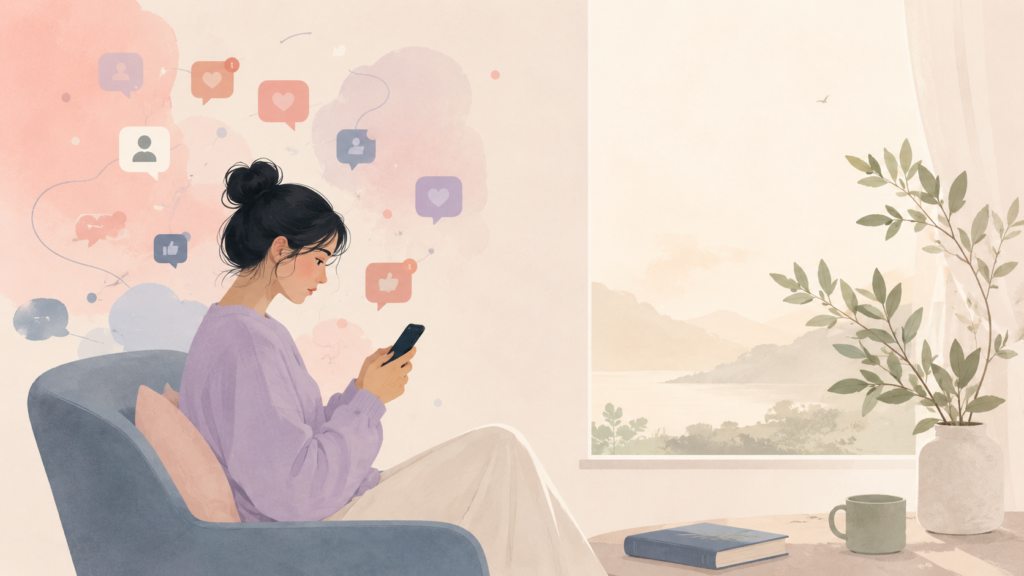
Have you ever picked up your mobile phone to check one message, only to realise that twenty minutes have passed?
Perhaps you opened social media briefly, but soon found yourself looking at someone’s holiday, career success, new home, family gathering or seemingly fulfilling life. Without consciously intending to compare, you began wondering whether you were falling behind.
This experience is often associated with the fear of missing out, commonly known as FOMO.
FOMO is not limited to teenagers or young adults. Many adults experience it without recognising it. It may appear as a quiet sense that something important, rewarding or exciting is happening elsewhere, and that we need to remain connected in case we miss it.
The phone is merely one doorway. FOMO can influence how we work, spend, socialise, make decisions and evaluate our lives.
What Can FOMO Look Like in Everyday Life?
FOMO does not always sound like, “I am afraid of missing out.” It may appear in ordinary habits and thoughts.
Social FOMO
You see photographs of friends gathering without you and immediately wonder why you were not invited.
You agree to attend an event even though you are physically tired because you worry that something important may happen in your absence.
You find it difficult to enjoy one gathering because you are checking what other people are doing elsewhere.
Career FOMO
You see someone announcing a promotion, qualification or business achievement and begin questioning your own progress.
You enrol in multiple courses because you fear becoming irrelevant, even though you have little time to apply what you have already learnt.
You keep changing direction whenever another career path appears more promising.
Instead of developing mastery in one area, you may remain anxious that another opportunity could be better.
Financial and Consumer FOMO
You purchase something because a promotion is ending soon.
You feel pressure to invest because everyone appears to be making money from a particular opportunity.
You upgrade a device that still works because the latest version seems to represent progress or status.
The decision may not come from genuine need. It may come from the discomfort of feeling left behind.
Relationship FOMO
You compare your marriage, friendships or family life with carefully selected images online.
You wonder whether other people are receiving more affection, attention or excitement than you are.
You may even struggle to appreciate a stable relationship because it does not look as interesting as the relationships presented on social media.
Information FOMO
You repeatedly check messages, news, emails and notifications because you feel that you must remain informed.
Even during rest, part of your attention remains available to the next alert.
You may tell yourself that you are merely staying updated. However, are you choosing when to receive information, or has information begun choosing when it receives your attention?
Spiritual or Personal Growth FOMO
FOMO can also enter spaces that appear positive.
You may compare your spiritual journey, healing, knowledge or personal development with someone else’s.
You may attend every programme, follow every speaker or try every new method because you fear missing the one answer that will finally transform your life.
Growth is helpful. However, constantly searching for the next experience can prevent us from practising what we have already received.
Why Do Adults Sometimes Miss the Signs?
Adults may not recognise FOMO because their behaviour can appear responsible or productive.
Constantly checking work messages may look like commitment.
Attending every event may look like sociability.
Taking numerous courses may look like ambition.
Following news throughout the day may look like awareness.
Buying the latest products may look like keeping up with change.
However, the difference lies in what is driving the behaviour.
Are you acting from a considered choice, or from anxiety?
Are you pursuing something meaningful, or trying to escape the discomfort of feeling excluded, inadequate or behind?
The activity itself may not be harmful. The concern arises when fear repeatedly directs the decision.
The Hidden Effects of FOMO
FOMO can gradually affect emotional wellbeing, attention and daily functioning.
Constant mental anticipation
When we repeatedly expect a new message, update or opportunity, the mind may remain in a state of anticipation. Even when nothing urgent is happening, we may feel compelled to check.
This can make genuine rest difficult.
The body may be sitting still, but the mind is waiting for the next stimulus.
Fragmented attention
Each notification invites the brain to shift direction.
After responding, we may return to our task, but our concentration has already been interrupted. When this happens throughout the day, sustained attention becomes increasingly difficult.
We may be busy for many hours while completing less meaningful work.
Comparison and dissatisfaction
Social media often presents selected moments rather than complete lives.
Yet, we may compare another person’s visible achievement with our private struggles. Their highlight becomes the standard against which we judge our ordinary day.
Over time, this can create dissatisfaction even when our own lives contain meaningful relationships, progress and opportunities.
Difficulty being present
FOMO draws attention towards what might be happening elsewhere.
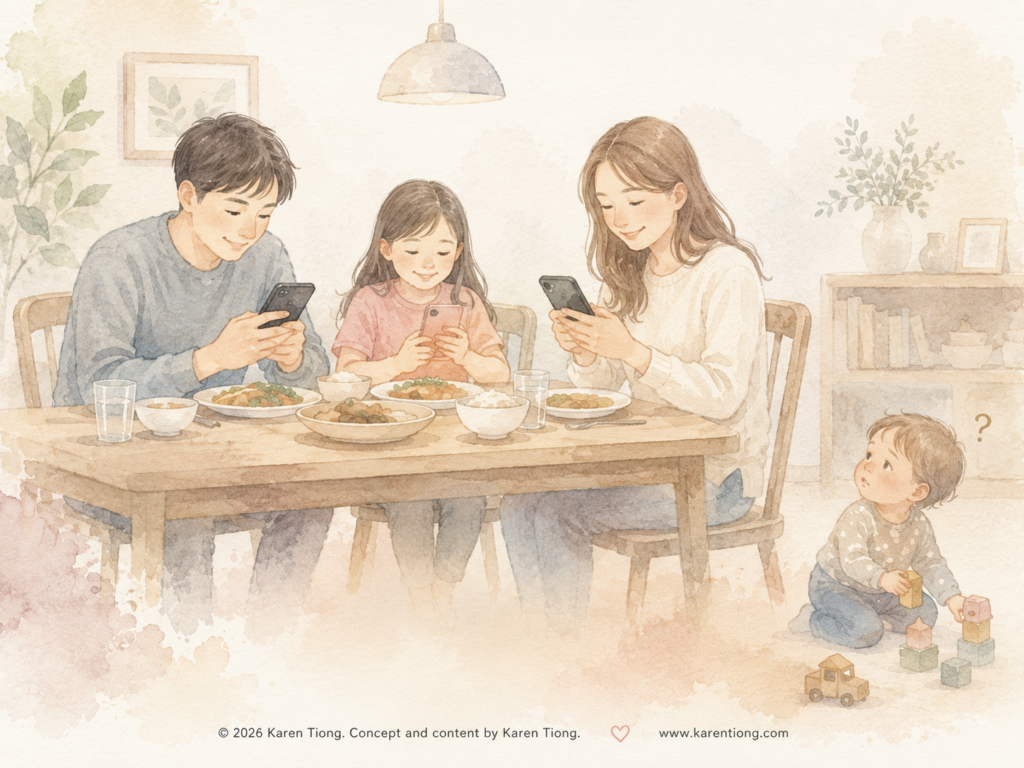
During meals, we check our phones.
During conversations, we notice notifications.
During family time, we scroll through other people’s families.
During rest, we think about work.
We may be physically present but psychologically divided.
Sleep disruption
Checking the phone late at night can delay sleep. The mind may also become emotionally activated by messages, news, comparisons or unfinished conversations.
We may enter bed intending to rest, while carrying the social world into the bedroom with us.
Decisions based on urgency rather than values
FOMO can influence us to say yes when we need to say no.
We may spend money we did not intend to spend, join activities we do not value or pursue goals that do not belong to us.
The fear of missing an opportunity can eventually cause us to miss something more important: a life shaped by our own values.
Could You Live One Day Without Your Mobile Phone?
Many adults remember a time before smartphones.
We travelled without continuously reporting our location.
We waited without scrolling.
We ate without photographing every meal.
We spent time with people without knowing what everyone else was doing.
We were not entirely free from comparison, worry or distraction. However, there were more natural spaces in which the mind could pause.
Could you return to that way of living for one day?
What feelings arise when you imagine switching off your phone?
Relief?
Anxiety?
Boredom?
Fear that someone may need you?
Concern that you might miss important news?
Discomfort because you would have to sit with your own thoughts?
The answer may reveal more than the number of hours recorded by your screen time report.
The question is not whether mobile phones are good or bad. They are useful tools that allow us to communicate, work, learn and receive support.
The more important question is this:
Are you using your phone, or has your phone begun organising your attention, emotions and daily rhythm?
What Might Happen in the Long Run?
Consider your present habits continuing for another five or ten years.
Will your ability to focus become stronger or weaker?
Will you feel more connected, or merely more informed about other people?
Will you become clearer about your direction, or increasingly distracted by every new possibility?
How many conversations will be partially heard?
How many quiet moments will be immediately filled?
How many personal goals will remain unfinished because attention was repeatedly redirected?
How much of your life will be spent watching other people live theirs?
These questions are not intended to create guilt. They are invitations to awareness.
Technology is unlikely to disappear. Therefore, the long term answer may not be complete avoidance. It may be learning to live with technology without surrendering our attention to it.
How Would You Like to Become Free From FOMO?
Freedom from FOMO does not require withdrawing from society. It begins by becoming more intentional.
You may start by asking yourself:
What am I afraid will happen if I do not check?
Whose life am I repeatedly comparing with mine?
What am I neglecting while keeping up with everyone else?
Which online activities leave me informed and connected?
Which ones leave me anxious, inadequate or mentally tired?
What deserves my undivided attention today?
You could also experiment with small changes:
Turn off nonessential notifications.
Keep the phone away during meals and conversations.
Choose specific times to read messages and social media.
Avoid beginning and ending the day with scrolling.
Unfollow accounts that repeatedly trigger unhealthy comparison.
Spend a few hours each week without social media.
Practise completing one task without checking the phone.
Notice the emotion that appears when you resist the urge to check.
The aim is not merely to reduce screen time. It is to recover the ability to choose where your attention goes.
A Final Challenge
Try spending one day without social media or, where practical, without your smartphone.
Before beginning, write down what you fear you might miss.
At the end of the day, ask yourself:
What did I actually miss?
What did I notice instead?
Did I feel calmer, more restless or more present?
What did I do with the time that became available?
What did the silence reveal about me?
You may discover that the greatest fear is not always missing what others are doing.
Sometimes, it is the fear of being alone with ourselves.
Yet, when we stop continually looking outward, we may begin to hear what our own mind, body, relationships and values have been trying to tell us.
Perhaps the goal is not to know everything that is happening.
Perhaps it is to become fully present in the life that is already happening in front of us.
Reflective Questions
- When do you feel the strongest urge to check your phone?
- Which people or situations trigger comparison in you?
- Have you ever agreed to something mainly because you feared missing out?
- What meaningful activity receives less attention because of your digital habits?
- What would you like to recover: concentration, rest, confidence, relationships or time?
- What is one boundary you are willing to practise this week?
Sources and Further Reading
Alutaybi, A., Al Thani, D., McAlaney, J., and Ali, R. (2020). Combating fear of missing out (FoMO) on social media: The FoMO R method. International Journal of Environmental Research and Public Health, 17(17), 6128. https://doi.org/10.3390/ijerph17176128
Gupta, M., and Sharma, A. (2021). Fear of missing out: A brief overview of origin, theoretical underpinnings and relationship with mental health. World Journal of Clinical Cases, 9(19), 4881–4889. https://doi.org/10.12998/wjcc.v9.i19.4881
Rozgonjuk, D., Sindermann, C., Elhai, J. D., and Montag, C. (2020). Fear of missing out (FoMO) and social media’s impact on daily life and productivity at work: Do WhatsApp, Facebook, Instagram, and Snapchat use disorders mediate that association? Addictive Behaviors, 110, 106487. https://doi.org/10.1016/j.addbeh.2020.106487
Tandon, A., Dhir, A., Almugren, I., AlNemer, G. N., and Mäntymäki, M. (2021). Fear of missing out (FoMO) among social media users: A systematic literature review, synthesis and framework for future research. Internet Research, 31(3), 782–821.
Disclaimer: This article is intended for general psychoeducation and reflection. It does not replace professional mental health assessment, diagnosis or treatment.